Tiber River
Quo VadisThe Tiber River is a practical and symbolic thread through the Roman scenes: a route for stone and grain, a meeting ground for people separated by status, and an obstacle that shapes movement through the burning city. Its banks connect the hidden labor of Christian workers to the crisis of the Great Fire, while the changing traffic across and along the river makes visible Rome’s dependence on movement and supply.
Work and fellowship along the river
The Tiber first appears as a working corridor. An old Christian slave explains that his son labors with other workers unloading stones from boats and carrying them to building sites at night, when deliveries will not obstruct the streets. The river’s commerce thus underlies the city’s construction, but the old man’s story also exposes the vulnerability of those who do the work: though he has gathered money to redeem his son, the son’s master takes the payment and keeps him enslaved. Chilo learns this account while searching for Christians, and the shared recognition signaled by a fish leads him into contact with the old man’s community.
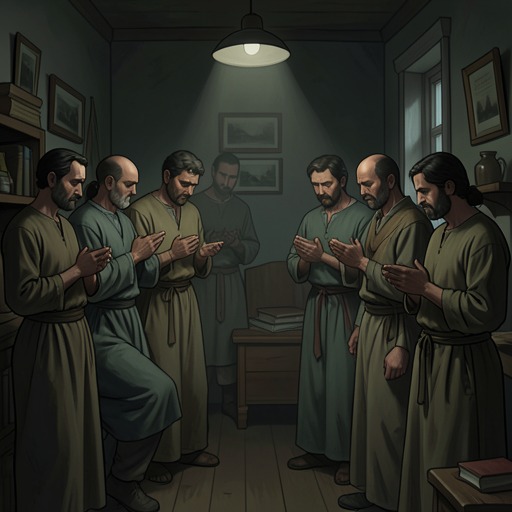
The riverbank becomes a place of Christian fellowship as well as labor. Vinicius follows Chilo at night and sees him give the old man a purse; the old man prays with raised hands beside the son whose freedom the money is meant to secure. Others gather around them, and Chilo makes signs in the air as the group kneels. The encounter gives Vinicius direct evidence of the community’s mutual assistance, even as he still hopes to use its members to find Lygia.
The river also enters the deception through which Chilo gains access to that community. Quartus tells him that many of the workers at Demas’s mill are Christians and that one of them belongs to the night shift. Their route toward the Emporium runs beside the river through the Porticus Aemilia, a shorter passage than going around the hill. The detail ties the Tiber’s urban geography to Chilo’s movement between working people and the hidden religious network he is infiltrating.
A route toward Lygia
When Chilo learns that Lygia will attend Peter’s teaching and baptism at the Ostrianum cemetery, he presents the Tiber as an alternative to watched city gates. The river, he argues, does not need gates, and Christians may have ways to reach the cemetery beyond the walls. His information draws on what Ursus has told him, including that Ursus will be present and intends to kill Glaucus. Vinicius, eager to find Lygia and convinced by the prospect of seeing her, agrees to go with Chilo to the gathering.
For Vinicius, the river is therefore more than a route: it is part of a plan to cross from surveillance into the concealed spaces where Christians worship. The search has not yet become an act of understanding. He wants to use what Chilo has uncovered to seize Lygia, and considers following Ursus or forcing a confession from him. The same river that carries Christian workers and enables secret access is drawn into a pursuit still governed by Vinicius’s possessive purpose.
Fire, crossings, and blocked passage
During the Great Fire, the river’s crossings determine whether Vinicius can reach the city’s far side. He rides from Antium after hearing the news, reaches the outskirts by way of relay horses, and asks a detachment of mounted Praetorians which part of Rome is burning. As he presses toward the city, the roads are crowded with people fleeing, and the fire makes passage through the gates increasingly difficult.
The crossing problem becomes explicit when Vinicius reaches the Appian Gate. The bridge near the Porta Trigemina has not yet been built; anyone seeking to cross the Tiber must instead reach the Pons Sublicius by going around the Aventine, through an area already engulfed in fire. Vinicius judges that route impossible. He must turn back toward Ustrinum, cross below the city, and approach the Trans-Tiber district by the Via Portuensis. In this moment, urban infrastructure is not background scenery: the absence of a bridge, the fire’s spread, and the crowding of the roads combine to redirect his journey.
The river also marks the fire’s changing edge. Peter tells the Christians that the flames, after reaching parts of the Trans-Tiber district, have turned back toward the river as the wind changes and have stopped advancing there. Peter then leaves with Vinicius and Chilo, promising that Linus and Lygia are near in a quarryman’s hut. The passage from threatened district to river and onward to refuge links the citywide disaster to Vinicius’s personal search.
Supply, disorder, and aftermath
In the days after the fire, the Tiber becomes a vital channel for relief. Ships, boats, and barges arrive from Ostia in such abundance that, as the narrative puts it, one could walk across them from one bank to the other. Wheat is sold cheaply and given to those in need; wine, olives, chestnuts, sheep, and cattle also reach the city. The influx helps avert famine, but it does not restore public order. Robbery, killings, and abductions continue amid the breakdown of authority and the temporary encampments around Rome.
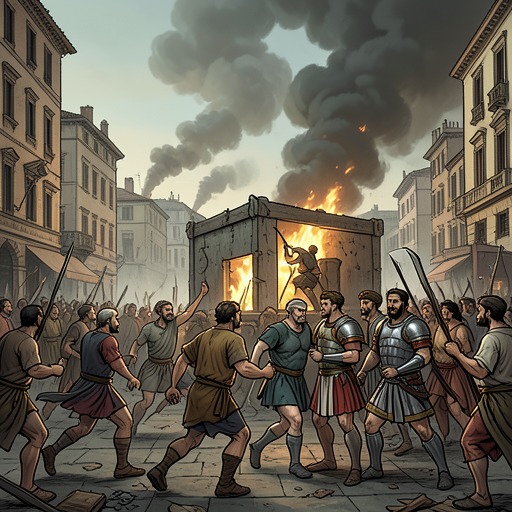
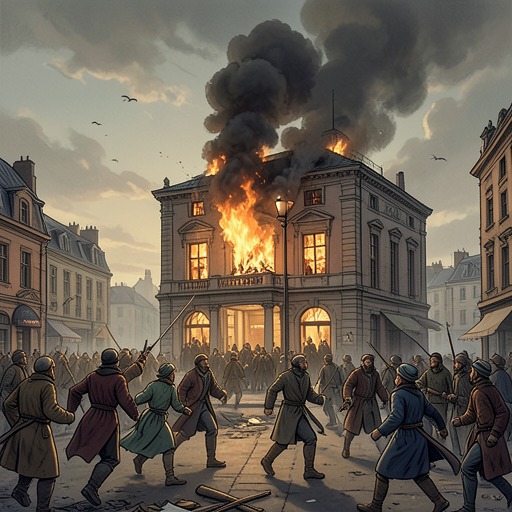
The crisis at the river’s supply points reveals how closely food provision and public security are linked. When the first major shipment of bread reaches the Emporium, the crowd breaks into the gate, seizes the stores, and fights over the loaves. Some bread is trampled into the ground; flour spills from torn sacks across the space by the granary and the arches of Drusus and Germanicus. Soldiers eventually take control of the building and disperse the crowd. The Tiber has brought food into the city, but the distribution system cannot initially protect that food from the desperation it is meant to relieve.
The river’s aftermath is also a record of violence and neglect. In the heat following the fire, bodies lie along its banks without anyone collecting them, and their decay contributes to the unhealthy conditions of the improvised camps. This detail stands in sharp contrast to the river’s earlier role as a route of labor and communal aid: the same waterside that connects workers, worshippers, and incoming supplies now borders a city whose institutions cannot maintain basic care.
Narrative significance
Across these episodes, the Tiber connects Rome’s ordinary economy to its extraordinary emergency. Before the fire, boats deliver stone for construction and the river’s routes help people move between work, community, and hiding places. During the disaster, its crossings become strategic bottlenecks and its changing edge helps define where flames advance. Afterward, its waterways carry the supplies that prevent famine, while its banks expose the human cost of collapsed order.
The river’s meanings remain material rather than merely emblematic: a slave’s chance at freedom depends on money earned through riverside labor; Vinicius’s route depends on where a bridge exists and where it does not; and Rome’s relief depends on boats bringing food from Ostia. By making these dependencies part of the characters’ movement and the city’s crisis, the Tiber shows how personal quests and imperial catastrophe are bound to the same fragile urban systems.